

The first three postulates of the Mass of Nows
1. The relativity of simultaneity requires there exist an infinite number of “now slices” through all four dimensions of space-time.
2. All particles must exist in all “now slices” through space-time. They do so by way of their wave function which permeates all four dimensions of space-time, and through quantum indeterminacy.
3. These four dimensional waves, when viewed from the three dimensional perspective of a single “now slice” take on the form of a particle.
The second three postulates of the Mass of Nows
1. Acceleration causes the mass being accelerated to alter its “now slice.”
2. While accelerating, the “now slice” becomes curved, causing it to pass through 1043 “nows” per second of time change.
3. Passage through the ZPE of each “now” is what causes inertial mass.
The third three postulates of the Mass of Nows
1. All mass moves through the four dimensions of space-time at the speed of light.
2. Operation of Newton’s 3rd law causes a warping of space-time in reaction to the mass’ passage.
4. This warping of space-time causes mass passing through it to pass through 1043 “nows” per second of time change, aka “gravity.”
Mass of Nows
Make everything as simple as possible, but not simpler. Albert Einstein.
While there is no concrete proof of the existence of gravitons, quantized theories of matter necessitate their existence. Supporting this theory is the observation that all other fundamental forces have one or more messenger particles, except gravity, leading researchers to believe that at least one most likely does exist; they have dubbed these hypothetical particles gravitons. Many of the accepted notions of a unified theory of physics since the 1970s, including string theory, superstring theory, M-theory, loop quantum gravity, all assume, and to some degree depend upon, the existence of the graviton. Many researchers view the detection of the graviton as vital to validating their work.
http://en.wikipedia.org/wiki/Quantum_gravity
The “Mass of Nows” theory (MON) uses relativistic effects to explain the existence of both gravitational and inertial mass without requiring a messenger particle. The strong, weak and electromagnetic forces describe matter interacting with matter within spacetime. General relativity asserts that gravity results from the interaction of matter with spacetime itself. MON focuses on this distinction to resolve the perceived conflict between the Standard Model and General Relativity.
Current theory is focused on the Higgs field as the source of mass and it is hoped that the LHC at Cern will produce evidence of this theorized but never experimentally verified “God Particle.”
If the “Mass of Nows” theory is correct, the physicists at Cern are in for a disappointment.
MON posits that Relativity requires quantum indeterminacy
Special relativity proved that motion through space reduces motion through time. When these two motions are added together they always equal the speed of light.
An unavoidable conclusion from relativity is that the universe must contain multiple “nows” that coexist. This is known in physics as “the relativity of simultaneity.” The Mass of Nows theory asserts that it is these multiple “nows” which make the wave aspect of all particles necessary, and quantum indeterminacy a foregone conclusion.
According to Newton’s absolute space and absolute time, everyone’s freeze-frame picture of the universe at a given moment contains exactly the same events; everyone’s now is the same now, and so everyone’s now-list for a given moment is identical. If someone or something is on your now-list for a given moment, then it is necessarily also on my now-list for that moment. Most people’s intuition is still bound up with this way of thinking, but special relativity tells a very different story.
Before Einstein introduced special relativity, the phrase ‘the whole of space at a particular time’ was thought to have exactly the same meaning for all observers. After Einstein’s work it was felt that each observer would understand what the phrase meant, but that different observers would disagree about what constituted the whole of space at a particular time. All observers would agree on what constituted space-time, but the way in which it was sliced up into space and time would differ from one observer to another, depending on their relative motion. No observer had the true view; they were all equally valid even though they might be different.
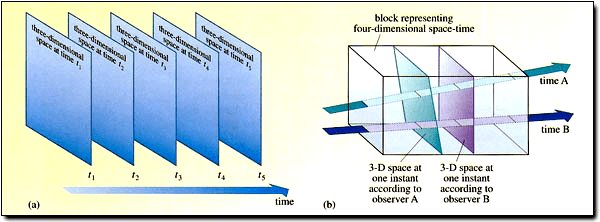
Figure 25: (a) The pre-Einsteinian view of space and time. Not only are space and time separate and distinct, they are also absolute. All observers agree on what constitutes space and what constitutes time, and they also agree about what it means to speak of ‘the whole of space at a particular time’. (b)The post-Einsteinian view in which space and time are seen as aspects of a unified space-time. Different observers in uniform, relative motion will each slice space time into space and time, but they will do so in different ways. Each observer knows what it means to speak of ‘the whole of space at a particular time’, but different observers no longer necessarily agree about what constitutes space and what constitutes time.
Through special relativity, Einstein showed that every observer cuts up spacetime into parallel slices that he or she considers to be all of space at successive instants of time, with the unexpected twist that observers moving relative to one another at constant velocity will cut through spacetime at different angles.
Two observers in relative motion have nows-single moments in time, from each one’s perspective-that are different: their nows slice through spacetime at different angles, And different nows mean different now-lists. Observers moving relative to each other have different conceptions of what exists at a given moment, and hence they have different conceptions of realty.
At everyday speeds, the angle between two observer’s now-slices is minuscule; that’s why in day-to-day life we never notice a discrepancy between our definition of now and anybody else’s. For this reason, most discussions of special relativity focus on what would happen if we traveled at enormous speeds-speeds near that of light-since such motion would tremendously magnify the effects.
Quantum Mechanics requires the wave function associated with particles to exist throughout all of space-time.
Particles “exist” in all nows; yet there is no way they can possibly exist in the same place in all “nows”. Schrodinger’s wave is neither “real” nor is it a mathematical convenience. It is a picture of the existence of the particle across all the “nows” of space-time.
Each of us exists in our own “now”. Through acceleration or gravity that “now” can be altered, but our change of “now” for ourselves does not affect the need for the particle to exist in all other “nows”. It therefore exists as a wave that allows it to exist in all different “nows”.
Particles produce interference patterns as a result of their wave nature across all of space-time. Measuring the location of a particle forces it to define itself in our particular “now” thereby eliminating the particle’s wave nature in our “now,” though it remains in all others.
Motion through warped space causes mass
According to General Relativity, for an object’s trajectory through spacetime to be straight, the object must not only move in a straight line through space, but its motion must also be uniform through time; that is, both its speed and direction must be unchanging and hence it must be moving with constant velocity.
If an observer should start accelerating, you might guess that the moment-to-moment changes in his speed and/or direction of motion would result in moment-to-moment changes in the angle and orientation of his “now” slices. Roughly speaking, this is what happens.
Einstein (using geometrical insights articulated by Carl Friedrich Gauss, Georg Bernhard Riemann, and other mathematicians in the nineteenth century) showed that the differently angled cuts through spacetime smoothly merge into slices that are curved but fit together as perfectly as spoons in a silverware tray.
Acceleration causes the object to warp its travel through space-time. Gravity causes the object to travel through space-time already warped.
MON asserts that it is the travel through warped space-time (i.e. multiple “now” slices) that causes the resistance, i.e the mass; both gravitational and inertial, of the object.
The source of the resistance is the vacuum energy responsible for the Casimir effect[1], which exerts a tiny but real interference, only detectable over huge distances.
Ordinary passage through the vacuum energy of space-time causes almost no resistance; however passage through multiple layers of the vacuum energies associated with each of the “nows” that is passed through, does.
Assuming different “nows” exist for each smallest unit of time, Plank Time, the resistance encountered would equal 1044 vacuum energies for each second of time changed in the “now”.
This could explain the famous Pioneer anomaly.[2] The tiny additional deceleration noted that was not accounted for by gravity, could have been caused by a vacuum energy resistance so small that it can only be measured over interstellar distances.
MON and Newton’s Third Law
If the passage of an object through the multiple layers of “nows” caused by acceleration through space time creates mass, what is the effect of such a passage on space time itself? Newton’s third law requires an opposite and equal effect to be generated.
That effect is clearly the very warping of spacetime caused by the accelerated motion. What is it that causes the warping? As an object moves through seas of “virtual particles” in each “now” it drags some of them with it into other “nows” causing the warping effect.
This effect is also illustrated by the recently experimentally confirmed Lense-Thirring effect, also known as “frame dragging. Brian Greene describes this effect as being similar to a “a spinning stone immersed in a bucket of syrup.”
Linear frame dragging is the similarly inevitable result of the general principle of relativity, applied to linear momentum. Although it arguably has equal theoretical legitimacy to the “rotational” effect, the difficulty of obtaining an experimental verification of the effect means that it receives much less discussion.
Impact of MON on Classical Physics
While MON changes nothing about classical physics, it provides a simple, underlying explanation for Newton’s first law. Also called the “law of inertia,” Newton’s first law states that a body at rest remains at rest and a body in motion continues to move at a constant velocity unless acted upon by an external force. The difficulty has always been that any form of resistance that occurs should occur regardless of whether an object was accelerating or in constant motion.
This is one of the major problems facing the Higgs field theory:
It is suggested that inertia is a fundamental property that has not been properly addressed by quantum field theory or superstring theory. The acquisition of mass-energy via a Higgs field may still require a mechanism to generate an inertial reaction force upon acceleration. Even when a Higgs particle is finally detected one may still need a mechanism for giving the Higgs-induced mass the property of inertia. The following discussion and articles are based on research carried out so far using only the techniques of stochastic electrodynamics. A goal of the Calphysics Institute is to explore whether these concepts can be reformulated, validated and generalized within the more comprehensive discipline of modern quantum field theory and superstring theory. http://www.calphysics.org/inertia.html
Impact of MON on General Relativity
MON manifestly reinforces Einstein’s concept of “equivalence” between acceleration and gravity. Instead of saying they are equivalent, it says they are identical.
The theory provides a logical explanation for why the curve of mass increase is so skewed near the speed of light. The closer an object approaches the speed of light, the more “nows” each increase in speed would need to cross. The object increases in mass until at the actual speed of light, (i.e. timelessness or all “nows”) it would have an infinite mass.
Impact of MON on the Standard Model
The largest impact MON has, is relieving the pressure to develop a theory of quantum gravity.
The central unanswered question which has eluded physics for nearly a century has been the conflict between its two most tested and trusted theories: General Relativity and Quantum Mechanics. The “Mass of Nows” theory posits that both theories remain precisely as they are today while relieving the conflict.
This removes the driving force behind both M theory and the quest for the Higgs Boson. It additionally removes the need for gravitons in the Standard Model to explain the force of gravity.
The explanation for the cosmological “expansion” now contained in the Big Bang theory is that at the super heated first picoseconds of the universe, the Higgs field could not exist and thus allowed for the expansion until it cooled sufficiently for the Higgs to emerge which gave mass to the particles.
MON suggests alternatively, that as spacetime expanded more “nows” came into existence which caused the particles to gain more and more mass as they needed to pass through more and more “nows” until they reached the 1044 per second mentioned earlier. Until enough “nows” existed, there was no gravitational effect, thus relieving the pressure to include it for calculations when the universe first existed at a quantum scale.
This is true also for the other major problem requiring gravity at quantum scales, i.e. black holes. General relativity predicts that time ceases to exist at the singularity, thus placing it outside the “nows” which would require gravity to be calculated together with the quantum fields.
Another major outstanding problem of the Standard Model is that most quantum field theories predict a huge cosmological constant from the energy of the quantum vacuum.
This conclusion follows from dimensional analysis and effective field theory. If the universe is described by an effective local quantum field theory down to the Planck scale, then we would expect a cosmological constant of the order of . The measured cosmological constant is smaller than this by a factor of 10-120. This discrepancy has been termed “the worst theoretical prediction in the history of physics!”
If the prediction of quantum field theory is divided by MON’s “nows” down to the Plank time scale, it may be that this prediction will turn out to be completely accurate. This is a mathematical problem that needs calculating.
MON also implies that Richard Feynman’s “sum over histories” approach is a direct description of reality rather than a simple mathematical short cut.
Impact of the theory MON on Quantum “Weirdness”
The “Mass of Nows” theory provides a logical explanation for wave particle duality. This duality underlies all of the problematic explanations for why the quantum world behaves so differently from the macro world.
Under the MON theory, particles which have to exist in all “nows” must act as waves in order to do so. Macro objects, as opposed to the particles from which they are composed, need not exist in all “nows,” and thus are under no such obligation.
The MON theory also provides an explanation for the “spooky action at a distance” associated with entanglement. Since the quantum wave exists in all “nows” simultaneously, any changes to the wave would naturally occur instantaneously throughout all of spacetime.
Unverified aspects of the MOW theory
The only unverified aspect of the theory is its presumption that vacuum energy causes a tiny, but real drag on objects moving through it. The Pioneer Anomaly provides the first possible evidence of this. More research is required to verify that this is indeed the case.
At minimum, the Casimir effect is proof positive that “virtual particles” do have an effect on macro objects.
There has been research done on the question of the contribution of the vacuum energy to inertial mass. This research is summed up with multiple references to different studies at http://www.calphysics.org/inertia.html
The intro to the web page states the following:
The Origin of Inertia
It is suggested that inertia is a fundamental property that has not been properly addressed by quantum field theory or superstring theory. The acquisition of mass-energy via a Higgs field may still require a mechanism to generate an inertial reaction force upon acceleration. Even when a Higgs particle is finally detected one may still need a mechanism for giving the Higgs-induced mass the property of inertia. The following discussion and articles are based on research carried out so far using only the techniques of stochastic electrodynamics. A goal of the Calphysics Institute is to explore whether these concepts can be reformulated, validated and generalized within the more comprehensive discipline of modern quantum field theory and superstring theory.
While the issue of inertial mass resulting from the ZPF (vacuum energy) is explored in numerous papers, none seem to take into account the massive multiplication this mass should encounter by moving through multiple “now” layers of spacetime.
Occam’s razor
Occam’s razor, entia non sunt multiplicanda praeter necessitatem, is the principle that “entities must not be multiplied beyond necessity” and the conclusion thereof, that the simplest explanation or strategy tends to be the best one. This is also known as the principle of parsimony, and is one of the cornerstones of judging a hypothesis in science.
MON relies only on phenomena that have already been identified and proven to exist. It makes no assertion of new or unseen forces.
The Mass of Nows theory eliminates the need for the multiple Higgs fields that have been proposed to explain gravity. It also eliminates the necessity for gravitons. The elusive “theory of everything” that motivates string and M theories, becomes superfluous.
If calculations bear out the predictions of MON, it is a far preferable explanation than the current model with its paradoxes, conflicts and hypotheses involving 11 dimensions as well as multiple, unobserved as yet, fields and particles.
[1] A small attractive force that acts between two close parallel uncharged conducting plates. Its existence was first predicted by the Dutch physicist Hendrick Casimir in 19481 and confirmed experimentally by Steven Lamoreaux, now of Los Alamos National Laboratory, in 1996.
The Casimir effect is one of several phenomena that provide convincing evidence for the reality of the quantum vacuum – the equivalent in quantum mechanics of what, in classical physics, would be described as empty space.
http://www.daviddarling.info/encyclopedia/C/Casimir.html
[2] The Pioneer 10 and Pioneer 11 deep space probes are not where they are supposed to be. Radio telemetry received from the spacecraft, over a period of many years before contact was lost with both probes, indicated that they are slowing down slightly more than expected with the result that each year they travel about 5,000 km (3,000 miles) less than mission controllers had projected. The slowing down is small, amounting to a deceleration towards the Sun of (8.74 ± 1.33) 10-10 m/s2, i.e. than a nanometer (a billionth of a meter) per second per second. This is equivalent to just one ten-billionth of the gravity at Earth’s surface. However, although tiny, the effect has been persistent over several decades. When mission controllers last heard from Pioneer 10, it was a quarter of a million miles from where it was supposed to be – roughly the distance from the Earth to the Moon. When NASA lost touch with Pioneer 11, several years earlier, it was heading for a similar deviation.
Ordinary passage through the vacuum energy of space-time causes almost no resistance; however passage through multiple layers of the vacuum energies associated with each of the “nows” that is passed through, does.
Assuming different “nows” exist for each smallest unit of time, Plank Time, the resistance encountered would equal 1044 vacuum energies for each second of time changed in the “now”.
This could explain the famous Pioneer anomaly.[1] The tiny additional deceleration noted that was not accounted for by gravity, could have been caused by a vacuum energy resistance so small that it can only be measured over interstellar distances.
MON and Newton’s Third Law
If the passage of an object through the multiple layers of “nows” caused by acceleration through space time creates mass, what is the effect of such a passage on space time itself? Newton’s third law requires an opposite and equal effect to be generated.
That effect is clearly the very warping of spacetime caused by the accelerated motion. What is it that causes the warping? As an object moves through seas of “virtual particles” in each “now” it drags some of them with it into other “nows” causing the warping effect.
This effect is also illustrated by the recently experimentally confirmed Lense-Thirring effect, also known as “frame dragging. Brian Greene describes this effect as being similar to a “a spinning stone immersed in a bucket of syrup.”
Linear frame dragging is the similarly inevitable result of the general principle of relativity, applied to linear momentum. Although it arguably has equal theoretical legitimacy to the “rotational” effect, the difficulty of obtaining an experimental verification of the effect means that it receives much less discussion.
Impact of MON on Classical Physics
While MON changes nothing about classical physics, it provides a simple, underlying explanation for Newton’s first law. Also called the “law of inertia,” Newton’s first law states that a body at rest remains at rest and a body in motion continues to move at a constant velocity unless acted upon by an external force. The difficulty has always been that any form of resistance that occurs should occur regardless of whether an object was accelerating or in constant motion.
This is one of the major problems facing the Higgs field theory:
It is suggested that inertia is a fundamental property that has not been properly addressed by quantum field theory or superstring theory. The acquisition of mass-energy via a Higgs field may still require a mechanism to generate an inertial reaction force upon acceleration. Even when a Higgs particle is finally detected one may still need a mechanism for giving the Higgs-induced mass the property of inertia. The following discussion and articles are based on research carried out so far using only the techniques of stochastic electrodynamics. A goal of the Calphysics Institute is to explore whether these concepts can be reformulated, validated and generalized within the more comprehensive discipline of modern quantum field theory and superstring theory. http://www.calphysics.org/inertia.html
Impact of MON on General Relativity
MON manifestly reinforces Einstein’s concept of “equivalence” between acceleration and gravity. Instead of saying they are equivalent, it says they are identical.
The theory provides a logical explanation for why the curve of mass increase is so skewed near the speed of light. The closer an object approaches the speed of light, the more “nows” each increase in speed would need to cross. The object increases in mass until at the actual speed of light, (i.e. timelessness or all “nows”) it would have an infinite mass.
Impact of MON on the Standard Model
The largest impact MON has, is relieving the pressure to develop a theory of quantum gravity.
The central unanswered question which has eluded physics for nearly a century has been the conflict between its two most tested and trusted theories: General Relativity and Quantum Mechanics. The “Mass of Nows” theory posits that both theories remain precisely as they are today while relieving the conflict.
This removes the driving force behind both M theory and the quest for the Higgs Boson. It additionally removes the need for gravitons in the Standard Model to explain the force of gravity.
The explanation for the cosmological “expansion” now contained in the Big Bang theory is that at the super heated first picoseconds of the universe, the Higgs field could not exist and thus allowed for the expansion until it cooled sufficiently for the Higgs to emerge which gave mass to the particles.
MON suggests alternatively, that as spacetime expanded more “nows” came into existence which caused the particles to gain more and more mass as they needed to pass through more and more “nows” until they reached the 1044 per second mentioned earlier. Until enough “nows” existed, there was no gravitational effect, thus relieving the pressure to include it for calculations when the universe first existed at a quantum scale.
This is true also for the other major problem requiring gravity at quantum scales, i.e. black holes. General relativity predicts that time ceases to exist at the singularity, thus placing it outside the “nows” which would require gravity to be calculated together with the quantum fields.
Another major outstanding problem of the Standard Model is that most quantum field theories predict a huge cosmological constant from the energy of the quantum vacuum.
This conclusion follows from dimensional analysis and effective field theory. If the universe is described by an effective local quantum field theory down to the Planck scale, then we would expect a cosmological constant of the order of . The measured cosmological constant is smaller than this by a factor of 10-120. This discrepancy has been termed “the worst theoretical prediction in the history of physics!”
If the prediction of quantum field theory is divided by MON’s “nows” down to the Plank time scale, it may be that this prediction will turn out to be completely accurate. This is a mathematical problem that needs calculating.
MON also implies that Richard Feynman’s “sum over histories” approach is a direct description of reality rather than a simple mathematical short cut.
Impact of the theory MON on Quantum “Weirdness”
The “Mass of Nows” theory provides a logical explanation for wave particle duality. This duality underlies all of the problematic explanations for why the quantum world behaves so differently from the macro world.
Under the MON theory, particles which have to exist in all “nows” must act as waves in order to do so. Macro objects, as opposed to the particles from which they are composed, need not exist in all “nows,” and thus are under no such obligation.
The MON theory also provides an explanation for the “spooky action at a distance” associated with entanglement. Since the quantum wave exists in all “nows” simultaneously, any changes to the wave would naturally occur instantaneously throughout all of spacetime.
Unverified aspects of the MOW theory
The only unverified aspect of the theory is its presumption that vacuum energy causes a tiny, but real drag on objects moving through it. The Pioneer Anomaly provides the first possible evidence of this. More research is required to verify that this is indeed the case.
At minimum, the Casimir effect is proof positive that “virtual particles” do have an effect on macro objects.
There has been research done on the question of the contribution of the vacuum energy to inertial mass. This research is summed up with multiple references to different studies at http://www.calphysics.org/inertia.html
The intro to the web page states the following:
The Origin of Inertia
It is suggested that inertia is a fundamental property that has not been properly addressed by quantum field theory or superstring theory. The acquisition of mass-energy via a Higgs field may still require a mechanism to generate an inertial reaction force upon acceleration. Even when a Higgs particle is finally detected one may still need a mechanism for giving the Higgs-induced mass the property of inertia. The following discussion and articles are based on research carried out so far using only the techniques of stochastic electrodynamics. A goal of the Calphysics Institute is to explore whether these concepts can be reformulated, validated and generalized within the more comprehensive discipline of modern quantum field theory and superstring theory.
While the issue of inertial mass resulting from the ZPF (vacuum energy) is explored in numerous papers, none seem to take into account the massive multiplication this mass should encounter by moving through multiple “now” layers of spacetime.
Occam’s razor
Occam’s razor, entia non sunt multiplicanda praeter necessitatem, is the principle that “entities must not be multiplied beyond necessity” and the conclusion thereof, that the simplest explanation or strategy tends to be the best one. This is also known as the principle of parsimony, and is one of the cornerstones of judging a hypothesis in science.
MON relies only on phenomena that have already been identified and proven to exist. It makes no assertion of new or unseen forces.
The Mass of Nows theory eliminates the need for the multiple Higgs fields that have been proposed to explain gravity. It also eliminates the necessity for gravitons. The elusive “theory of everything” that motivates string and M theories, becomes superfluous.
If calculations bear out the predictions of MON, it is a far preferable explanation than the current model with its paradoxes, conflicts and hypotheses involving 11 dimensions as well as multiple, unobserved as yet, fields and particles.

 4D - The Mass of Nows
Leave a comment